

Corporate & Commercial
Arbitration & Dispute Resolution
After Home Care Retail Marts[1], the Supreme Court's latest Section 9 decision poses a tougher question: once the losing party is allowed legal protection, how far may the court go without turning interim protection into an appeal against the award? The concept of arbitration rests on finality. Section 34 of the Arbitration and Conciliation Act, 1996 ("the Act") provides the statutory framework for challenging an award, while Section 36 governs its enforcement subject to the statutory scheme. Section 9, meanwhile, provides interim protection to preserve the subject matter of the dispute, though it cannot become a substitute for adjudication on the merits. The tension escalates after an award: what remains capable of protection when the applicant has lost the arbitration? In National Projects Construction Corporation Ltd. v. Ishvakoo (India) Pvt. Ltd.[2] ("NPCC judgment"), the Supreme Court upheld an order directing National Projects Construction Corporation Ltd. (NPCC) to deposit ₹3.5 crore, although Ishvakoo had lost its substantive claims before the arbitral tribunal. The Court neither granted restitution nor decided the pending Section 34 challenge. Instead, it preserved the disputed amount in neutral custody. That distinction is central to NPCC judgment[3]. The decision permits, in exceptional circumstances, preservation of the disputed subject matter without deciding the substantive consequences of the award under challenge. Factual Background The dispute arose from a 2002 arrangement concerning bus terminus works in Agra, under which NPCC released ₹3.5 crore to Ishvakoo as mobilisation advance against bank guarantees. In 2003, Ishvakoo approached the Delhi High Court under Section 9 to restrain invocation. A December 2005 order required the guarantees to remain alive through arbitral adjudication and, if a Section 34 challenge followed, until its disposal. Encashment was contemplated only if, upon the award becoming executable, the award entitled NPCC to recov
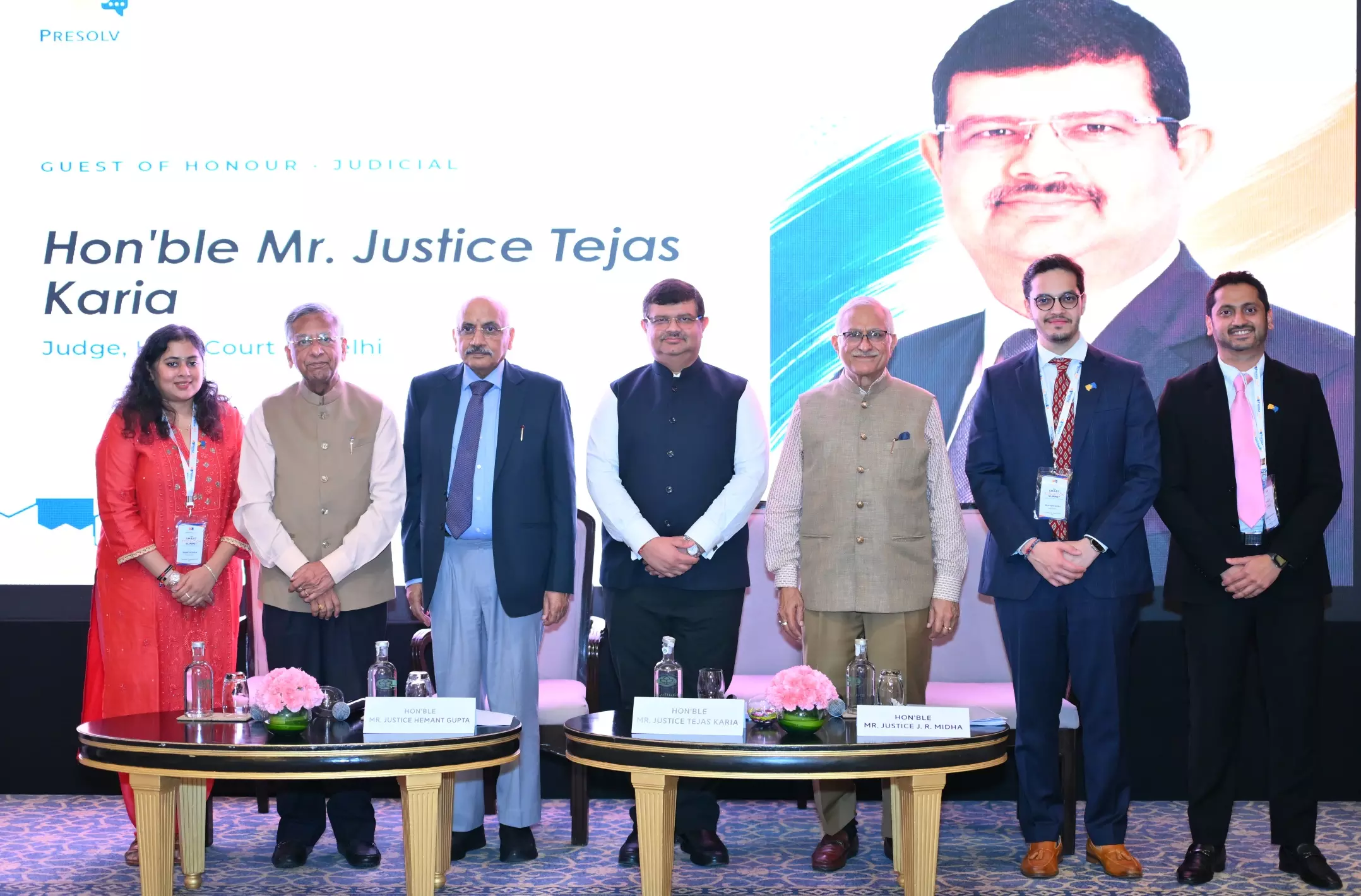
As part of efforts to strengthen institutional arbitration and promote technology-driven frameworks through Online Dispute Resolution (ODR), Presolv360 hosted its Smart Resolution Summit on Thursday. The event brought together retired and sitting judges, senior government officials, and industry leaders to deliberate on the future of dispute resolution in India. The summit featured a keynote address by Attorney General for India R. Venkataramani, a plenary session with addresses by Justice Hemant Gupta, Justice Tejas Karia and Justice J.R. Midha, and a panel discussion on policy and legal perspectives relating to institutional arbitration and ODR. Setting the tone for the summit in his keynote address, Venkataramani remarked, “The adversarial system is mechanical,” adding that “we need to talk with emotion about dispute resolution.” His address was followed by a plenary session featuring Justice Hemant Gupta, Justice Tejas Karia and Justice J.R. Midha. Speaking at the session, Justice Karia emphasized that “dispute resolution must continue to evolve with the needs of society.” He, along with Justice Gupta, spoke about the value of ODR in resolving large volumes of disputes. They highlighted how ODR is already addressing dispute resolution challenges across various industries and urged the legal community to embrace it. Justice Midha underscored the need to improve efficiency in arbitration through technology-backed processes. The event also witnessed the launch of Presolv360's AI Library for Arbitration in the presence of the dignitaries. Released as an open-source tool, the AI library aims to help the arbitration community access precedents, principles and insights more efficiently, while enabling practitioners and researchers to contribute to its growing body of knowledge. The summit also featured a panel discussion bringing together perspectives from policy, regulation and practice. Representing NITI Aayog, Dr. Banusri Velpandian, Senior Specialist, noted that se

LiveLawBiz is LiveLaw's dedicated platform for arbitration and dispute resolution laws. If you follow developments in domestic and international arbitration, commercial disputes, enforcement of awards or related regulatory matters, we invite you to visit LiveLawBiz for more specialised and comprehensive coverage. LiveLawBiz brings you: - • IPR • GST/VAT/CST • Competition Law • RERA • Tax • IBC While selected major arbitration developments will continue to appear on LiveLaw, more detailed and regular coverage is now available on LiveLawBiz. Stay ahead of developments that matter to business and practice. If you feel any important judgment or legal development with regard to Arbitration should be reported, please notify us at: info@livelaw.in & sahyaja@livelawbiz.com. Visit LiveLawBiz for the latest arbitration and commercial dispute law updates.
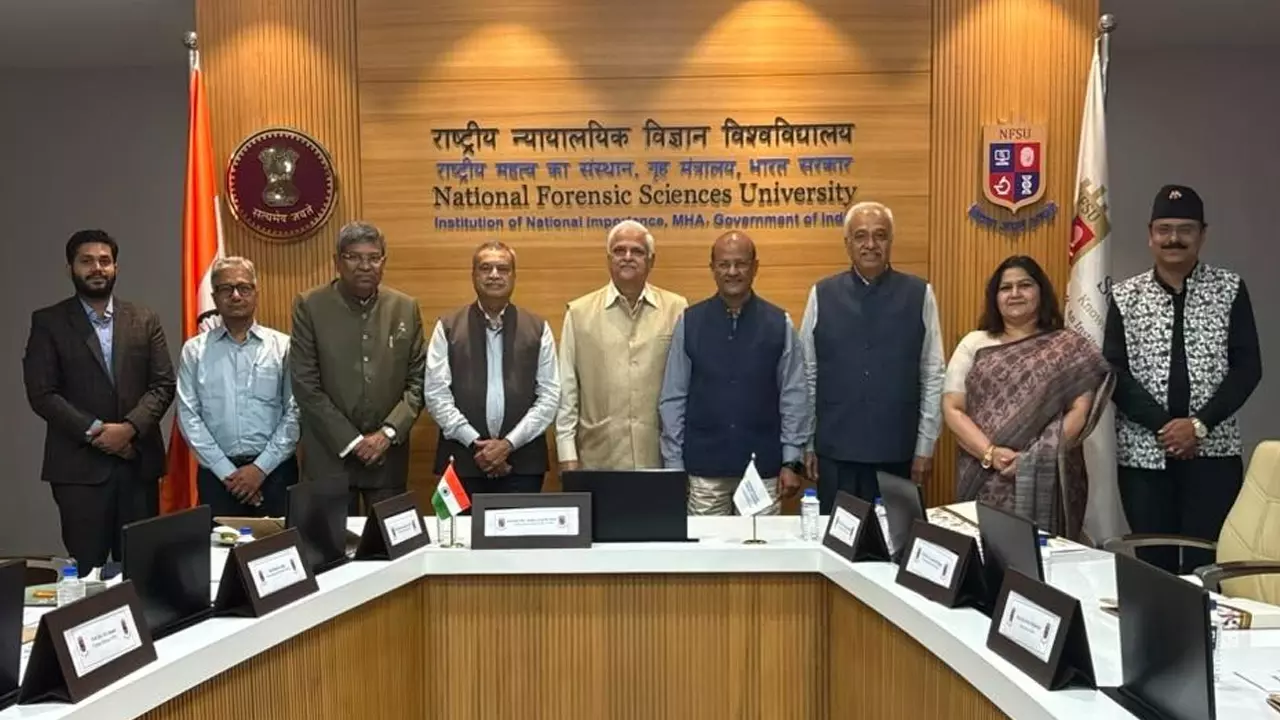
The National Forensic Sciences University (NFSU) on Sunday, August 23, 2026, held the first meeting of the Board of Governors of its International Digital Dispute Resolution Centre (IDDRC) at its Gandhinagar campus. The Board unanimously nominated former Supreme Court judge Justice A.R. Dave as the President of IDDRC and formally declared the Centre operational as an institutional provider of arbitration and mediation services. IDDRC was inaugurated on February 27, 2026, by Chief Justice of India Surya Kant in the presence of Gujarat Deputy Chief Minister Harsh Sanghavi and Gujarat High Court Chief Justice Sunita Agarwal. NFSU stated that the Centre has been conceived as a digital-first institution for arbitration and mediation, integrating technology into dispute resolution processes. Its framework incorporates AI-enabled capabilities and blockchain-integrated systems, with confidentiality, data protection, traceability and auditability forming part of its institutional architecture. The first Board of Governors meeting was attended by former Supreme Court judges Justices A.R. Dave, M.R. Shah and Rajesh Bindal, former Gujarat High Court Chief Justice Sonia Gokani, former Gujarat High Court judge Justice P.P. Bhatt, and Senior Advocate Ratan Singh, Chairman of the Society of Construction Law, India. The Board's decision to operationalise the Centre marks the commencement of its arbitration and mediation services. NFSU stated that, following its operationalisation, IDDRC has invited expressions of interest from domain-expert arbitrators, with emphasis on professional credibility, relevant experience and subject-matter expertise.

The Real Estate (Regulation and Development) Act, 2016 (RERA) provides for dispute resolution mechanisms through specialized forums, including Conciliation Forums established under Section 32(g) and the Real Estate Appellate Tribunal (REAT) under Section 44. Under the RERA Act, the RERA authorities are not empowered to accept or enforce any settlement unless it has been passed through the Conciliation Forum established for dispute resolution. Ideally when a dispute arises between promoters and allottees, it should be referred to the conciliation forum where both parties are invited for a hearing facilitated by conciliators, who are typically representatives from consumer and promoter associations alongside RERA officers. If the parties reach an agreement, a consent settlement is drawn up and signed by both sides, and this signed agreement is vetted and certified by the Conciliators. This consent agreement is then uploaded on the RERA portal, making it binding and final. If either party fails to comply with the settlement terms, it is treated as a breach, and further legal action can be initiated before the RERA adjudicating authority. No settlement can be considered valid or accepted by the authority itself unless it has gone through this formal conciliation process, ensuring that the resolution is consensual and legally binding. If the conciliation fails, the dispute proceeds to formal adjudication. This process helps save time and costs associated with litigation while providing an amicable path to dispute resolution under the RERA framework. Notably, the Act itself does not contain any other provisions mentioning the term "settlement" outside the conciliation forum, emphasizing that only those settlements should be formally approved which are passed through these specialized dispute resolution forums. The only alternative judicial remedy available under RERA for parties seeking resolution is to get the matter referred for settlement before Lok Adalat or file an a
Parliament has recently passed the Micro, Small and Medium Enterprises Development (Amendment) Bill 2026 (“Amendment Bill”) in the current monsoon session. The Rajya Sabha passed the Amendment Bill by voice vote on 3 August 2026, and the Lok Sabha followed on 7 August 2026. The Bill now awaits the assent of the President. The use of conciliation and arbitration under the Arbitration and Conciliation Act, 1996 (“Arbitration Act”), with a limited timeline of 90 days and interest compounding at monthly rests was a deliberate design to compel defaulting parties to promptly pay the outstanding amounts owed to MSMEs. However, in a system plagued with delayed adjudication and cases pending for years, the 90-day timeline got pushed to the background. The mechanism implemented with the intention of providing a simple and effective remedy for recovery of money eventually metamorphosed into a highly contested dispute resolution, leading to substantial delays. The data on the MSME Samadhaan website is evidence of the fact that a huge number of cases remain pending, depriving MSMEs of crucial funds to operate their businesses. This reflected a pain point for the MSME sector as well as the government. Consequently, it is understandable that the most emphasis in the Amendment Bill has been placed on this aspect of the MSME Act. Why an Amendment was Overdue Three separate issues led to the majority of the amendments in the Amendment Bill. The first issue pertained to structural rigidity. Section 7 of the MSME Act classified the micro, small, and medium enterprises (“MSMEs”) on the basis of fixed investment and turnover thresholds. The 2020 revision of these thresholds had already been achieved through notification under the existing section 7, and the drafters of the 2026 Bill have simply completed that logic by removing the numbers from the MSME Act altogether and leaving the Central Government to notify them, indicating an important step considering the composition in the MSME se

The Recurring Question One question has consistently tested the boundaries of judicial intervention in arbitration, namely, whether a party dissatisfied with an order of an Arbitral Tribunal, typically one rejecting a jurisdictional objection under Section 16 of the Arbitration and Conciliation Act, 1996 (herein after referred to as “the Act”), run to the High Court under Article 227 of the Constitution instead of waiting for the final award? The Supreme Court has answered this question repeatedly over two decades, most recently in Manash Kamal Bezboruah v. M/s Bokahola Tea Company (P) Ltd. Yet High Courts continue to entertain such petitions with troubling regularity. Against this backdrop, this article examines the Supreme Court's evolving jurisprudence and the limited room it leaves for supervisory intervention during arbitral proceedings. The Statutory Design Against Judicial Intervention A non-obstante provision under section 5 states that, “notwithstanding anything contained in any other law for the time being in force, in matters governed by this Part, no judicial authority shall intervene except where so provided in this Part.” This reflects the Act's underlying objective of minimising judicial intervention, consistent with the UNCITRAL Model Law on International Commercial Arbitration, 1985. Complementing Section 5 is Section 16, India's codification of the doctrine of Kompetenz-Kompetenz, which provides that, “The arbitral tribunal may rule on its own jurisdiction, including ruling on any objections with respect to the existence or validity of the arbitration agreement, and for that purpose, (a) an arbitration clause which forms part of a contract shall be treated as an agreement independent of the other terms of the contract; and (b) a decision by the arbitral tribunal that the contract is null and void shall not entail ipso jure the invalidity of the arbitration clause.” This formulation mirrors Article 16(1) of the UNCITRAL Model Law, which empowers the
The Supreme Court on Monday (August 17) referred the question to a larger Bench as to whether pre-deposit conditions in arbitration clauses, requiring contractors to deposit a percentage of the claim amount before invoking arbitration, are valid. A bench of Justice Manoj Misra and Justice Manmohan expressed doubt about the binding nature of the three-judge Bench decision in S.K. Jain v. State of Haryana (2009) 4 SCC 357, which had upheld the legality of pre-deposit clauses in an arbitration agreement. The Court endorsed the decision of a two-judge bench in ICOMM Tele Ltd. vs. Punjab State Water Supply (2019), which had struck down the pre-deposit clauses, calling them ineffective and making arbitration expensive. Because the two-judge judgment of ICOMM (supra) could not override the principle of law enunciated by the three-judge Bench in S.K. Jain. (supra), the Court requested the Chief Justice of India to consider the desirability as to whether the issues formulated hereunder, or such other issues as may be deemed relevant, do warrant a reference to a larger Bench: “A. Whether a stipulation requiring the contractor alone to make a pre-deposit of security/fees prior to reference of disputes to arbitration is contrary to Section 18 of the Act which mandates equal treatment of parties at all stages of arbitration? B. Whether pre-deposit conditions in contracts having an arbitration clause discourages Alternative Dispute Resolution and undermine its objective of declogging the court system? C. Whether a condition of pre-deposit of security/fees prior to reference to Arbitration is arbitrary and violative of the right to sue as well as Article 14 of the Constitution and Section 28 of the Indian Contract Act, 1872? D. Whether requirement of pre-deposit of security/fees has any rational relation to the object of curbing frivolous claims as at that stage it cannot be said that the claims are frivolous and moreover such frivolous claims may adequately be addressed under Sec
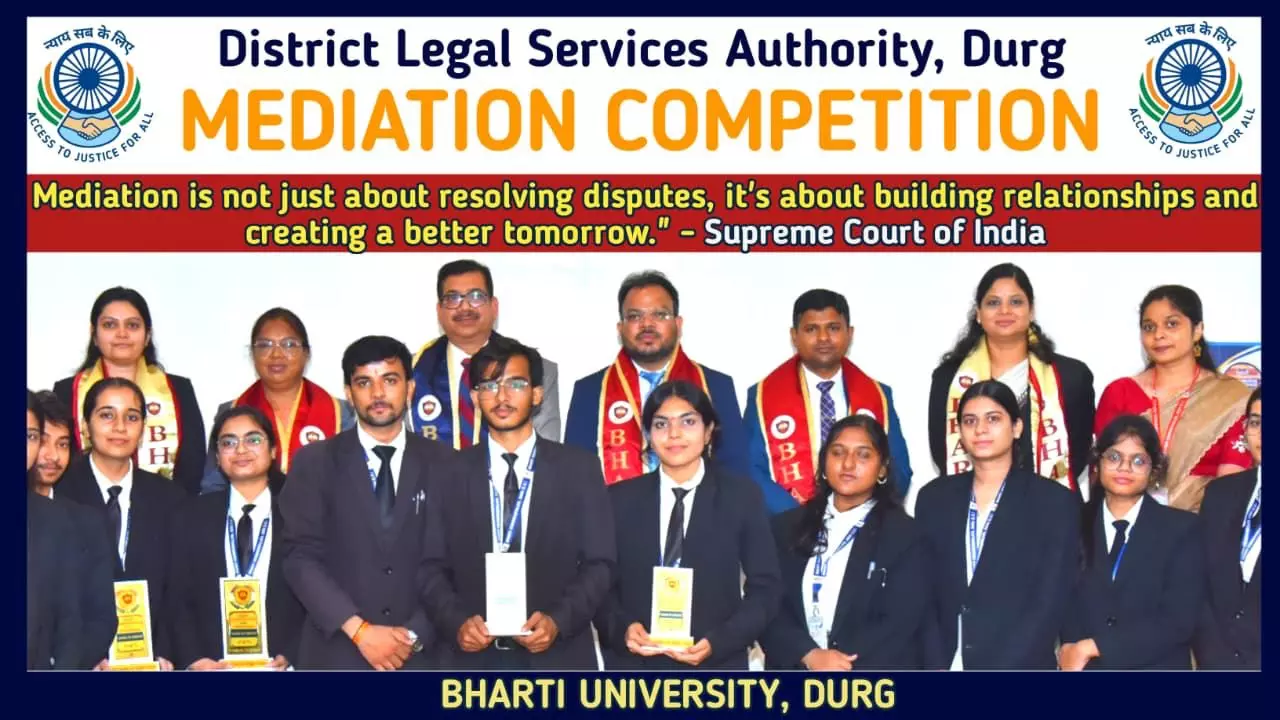
The District and Sessions Court, Durg, in association with the District Legal Services Authority (DLSA), Durg, organised a Student Mediation Competition at Bharati University, Durg, under the theme “Taking Mediation to the Roots Through Campus-Based Mediation Competitions – An Initiative under Mediation 3.0 Drive.” The initiative seeks to introduce students to mediation and consensual dispute resolution before disputes reach the courtroom. It is part of the broader vision of Justice Ramesh Sinha, Chief Justice of the High Court of Chhattisgarh, to strengthen mediation as an integral part of justice delivery, with institutional guidance from Justice P.P. Sahu. The competition featured two simulated disputes. One involved neighbouring families divided over the construction of a window, with one side seeking light and ventilation for an elderly mother and the other raising privacy and security concerns. The second concerned two brothers' dispute over their late father's family business, with one seeking his share to meet his daughter's higher education expenses while both wished to preserve the business. The propositions encouraged students to identify the interests underlying the parties' stated positions, highlighting the importance of communication, empathy, negotiation and creative problem-solving in mediation. The programme also emphasised that mediation should not be viewed merely as a tool for reducing judicial pendency, but as a means of promoting access to justice and preserving relationships where appropriate. The Mediation Act, 2023 and Article 39A of the Constitution were highlighted in this broader context. The programme was attended by Shri Anish Dubey, District and Additional Sessions Judge, Durg; Smt. Sushma Lakra, Chairman, Permanent Lok Adalat, Durg; Shri Bhupesh Kumar Basant, Chief Judicial Magistrate, Durg; Shri Umesh Kumar Bhagwatkar, Secretary, DLSA, Durg; Smt. Kamini Jaiswal, Civil Judge (Senior Division), Durg; and Smt. Aishwarya Diwan, Civil Ju
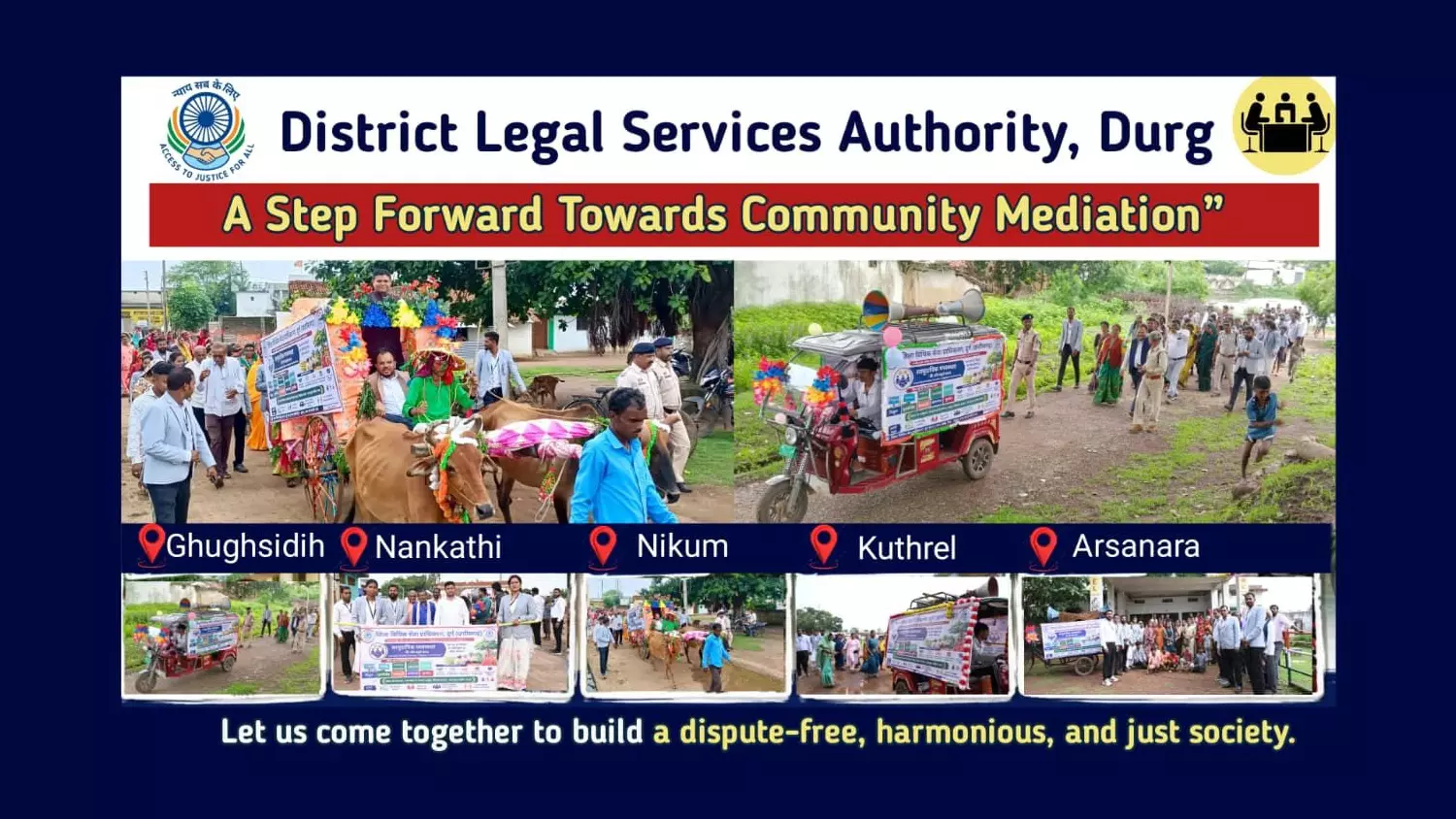
The District Legal Services Authority (DLSA), Durg, conducted a five-day grassroots legal awareness and community mediation campaign covering five villages under the initiative “Five Villages, Five Days, One Resolve — Resolution Through Dialogue, Not Dispute.” The initiative was conducted under the guidance of K. Vinod Kujur, Principal District & Sessions Judge and Chairman, DLSA Durg, with the objective of taking legal awareness and access to justice directly to rural communities through village chaupals. 'Justice on Wheels' On Hareli The highlight of the campaign was at Gram Nikum on the occasion of Hareli, the traditional harvest festival of Chhattisgarh. The DLSA team decorated a traditional bullock cart as “Justice on Wheels” and travelled through the village along with law students, faculty members and Para-Legal Volunteers. The outreach team comprised Sushma Lakra, President, Permanent Lok Adalat; Bhupesh Kumar Basant, Chief Judicial Magistrate; and Umesh Kumar Bhagwatkar, Secretary, DLSA Durg.�The campaign also included tree plantation activities, linking environmental sustainability with social justice. Legal Awareness Across Five Villages The campaign covered Ghughsidih, Nankatthi, Arsanara, Nikum and Kuthrel. Law students and faculty members from law colleges in Durg, including Kalyan Law College, participated alongside DLSA officials, PLVs and trained community mediators. The team conducted street rallies and interactive sessions on free legal aid, Lok Adalats, digital safety and community mediation. Villagers were encouraged to resolve family, neighbourhood and property disputes amicably through pre-litigation mediation rather than allowing minor disagreements to develop into prolonged litigation. At Nankatthi, sessions were held on legal rights, career opportunities and digital safety, with students being advised never to share OTPs, avoid suspicious links and protect their banking and personal information. At Kuthrel, Chhattisgarhi folk songs were use
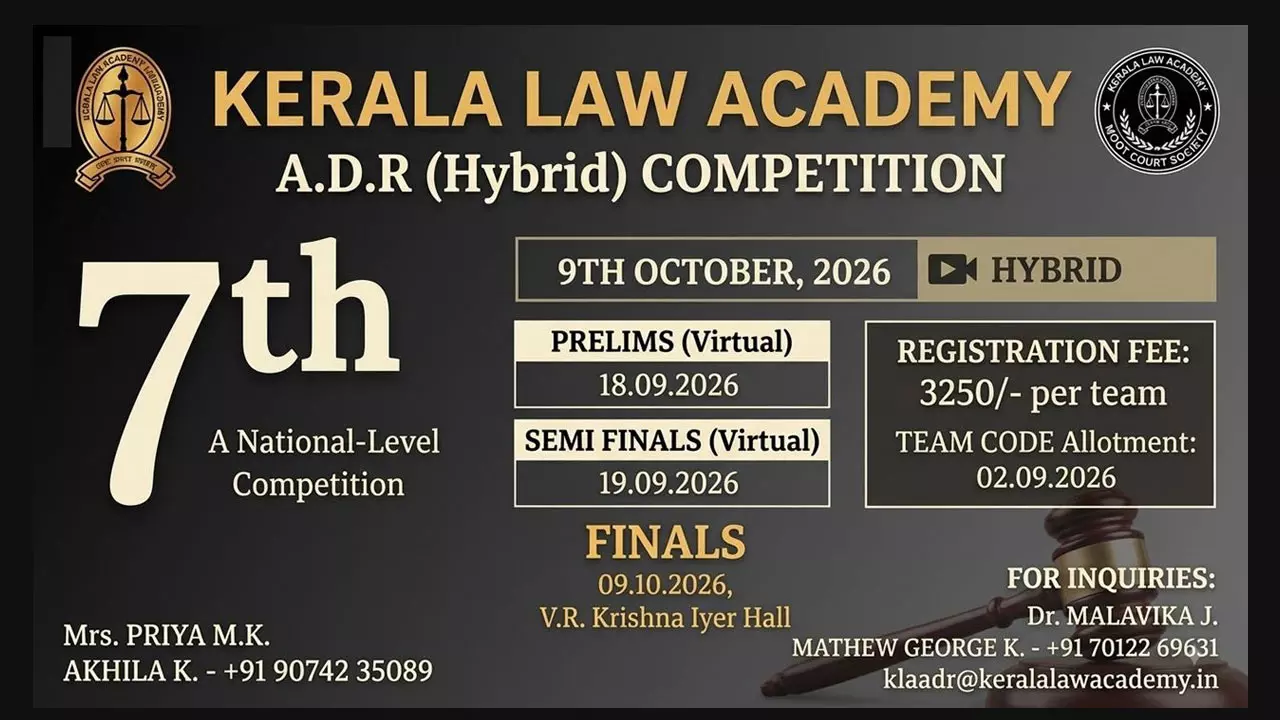
The Kerala Law Academy Law College (KLA), Thiruvananthapuram, in association with the Moot Court Society (MCS) and IQAC KLA, warmly invites law students across India to participate in the 7th Edition of the Kerala Law Academy National ADR Competition, 2026. Designed to foster practical mastery in Alternative Dispute Resolution, negotiation, conciliation, mediation, and international arbitration, this flagship event provides a realistic platform for law students to simulate complex commercial dispute resolution mechanisms. About the Institution Established in 1966, Kerala Law Academy Law College (KLA) stands as one of India's premier legal education institutions, affiliated with the University of Kerala and approved by the Bar Council of India. Over nearly six decades, KLA has built a legacy of academic rigor, pioneering research through CALSAR, and publishing the Academy Law Review, one of India's oldest peer-reviewed journals. About the Competition & Propositions The competition challenges teams across three distinct legal problems representing different ADR mechanisms: Preliminary Round — Conciliation (Virtual): Problem Focus: Commercial distribution dispute between Astera Pharmaceuticals Ltd. and LifeCare Medical Distributors Pvt. Ltd. concerning direct digital procurement, breach of exclusivity, and supply suspension. Time Allotted: 30 minutes per session. Semi-Final Round — Mediation (Virtual): Problem Focus: Service contract and reputational damage dispute between Aarav Hospitality Pvt. Ltd. and Epicure Events LLP involving out-of-scope services, payment withholding, and social media claims. Time Allotted: 40 minutes per session. Final Round — International Arbitration (Offline): Problem Focus: USD 420 Million EPC cross-border offshore wind turbine project dispute between OceanWind Energy India Ltd. and NordTech Marine Solutions A/S (Denmark), seated in Singapore, involving force majeure, export controls, and USD 45 Million liquidated damages. Time Allotted: 4
![Roundtable On 'Building The Next Generation Of Dispute Resolution Professionals' By Sama, Bengaluru [August 20; In-Person; Open To ADR Profs. & Deans; Free]: Register By August 19](https://www.livelaw.in/h-upload/2026/08/14/694006-34245.webp)
Sama is India's leading Online Dispute Resolution (ODR) platform, enabling mediation, arbitration, and conciliation entirely online for businesses, government bodies, and individuals.Since 2019, Sama has facilitated the filing of over 2 crore disputes and the resolution of more than 34 lakh cases, with an average resolution time of 45 days.�Sama is headquartered in Bengaluru and is also the organiser of Indian Mediation Week. About the Roundtable Sama is hosting a roundtable bringing together Deans, ADR professors, and faculty from law schools across Karnataka and neighbouring states, to discuss the future of dispute resolution careers and how academia and industry can build lasting pathways together. The evening will cover: ● A keynote address by Shahzar Hussain, Senior Consultant at Vahura, on how legal hiring is evolving and how students can prepare for emerging careers ● What today's legal industry actually needs from graduating students, practice-readiness, ADR, and legal-tech skills ● The growing opportunity landscape across litigation, judiciary, policy, legal tech, mediation, ODR, and case management ● How law schools and Sama can collaborate through internships, workshops, research, faculty development, and ADR clinics ● A first look at Indian Mediation Week 2026 (its 10th edition!) and the Student Ambassador Programme ● A story from a current Sama Case Manager on how the role shaped their legal career After the roundtable, attendees will have the chance to connect across institutions during an open discussion and dinner. About the Keynote Address The roundtable will open with a keynote by Shahzar Hussain, Senior Consultant at Vahura, India's leading legal recruitment and talent advisory firm. Drawing on Vahura's work placing candidates across law firms, in-house teams, and funds, Shahzar will speak on how legal hiring is changing and how law schools can prepare students for careers beyond traditional litigation and law firm roles, including in mediation, O

The Gujarat State Legal Services Authority (GSLSA) organized a two day Community Mediation Training Programme for mediators belonging to trading community under the Community Mediation (Trading Community) Initiative. As per a GSLSA press release, this initiative is the first of its kind in the country and aims to institutionalize the tradition of amicable dispute resolution within trade and business communities.� The training programme was conducted by trained trainers of of GSLSA designed in accordance with provisions of the Mediation Act 2023, the NALSA Community Mediation Training Module and guidelines of mediation and conciliation project committee. Participants were imparted with practical knowledge of mediation principles, communication skills, negotiation techniques, ethics, neutrality etc.� Gujarat High Court Chief Justice Sunita Agarwal, patron-in-chief of GSLSA and Justice Alpesh Y Kogje the Executive Chairman GSLSA graced the training session and interacted with the participants.� Click Here To Read/Download Press Release
The Supreme Court on Tuesday (August 11) held that to prevent an award holder's enrichment of a bank guarantee while an award was under challenge, an interim relief under Section 9 of the Arbitration & Conciliation Act, 1996 can be extended on an award debtor's application to preserve the efficacy of the challenge in Section 34. A bench of Justice KV Viswanathan and Justice Alok Aradhe refused to interfere with the Delhi High Court's judgment, which had allowed the Respondent-award debtor's Section 9 application which sought an interim relief against alleged unjust enrichment of a bank guarantee of about Rs. 3.5 crores by an Appellant-award holder during the pendency of a Section 34 application. The bench noted that there are precedents holdig that a post-award Section 9 application is maintainable in exceptional cases. “This Court, while holding the application to be maintainable, has sounded a note of caution that the threshold for grant of interim relief will be higher in case the application is moved by an Award Debtor and that a court may, in rare and compelling cases, permit the unsuccessful party to invoke Section 9 to prevent irreparable prejudice and to preserve the efficacy of the challenge under Section 34…the High Court was justified in observing that permitting the appellant to hold on the money pending Section 34 application, would be unjustly enriching the appellant…”, the Court observed. The dispute arose from a Memorandum of Understanding executed in 2002 between National Projects Construction Corporation Ltd. and Ishvakoo India Pvt. Ltd., pursuant to which the respondent was provided Rs. 3.5 crores as Mobilisation Advance against bank guarantees. In 2005, the High Court disposed of a Section 9 application with the understanding that the appellant would not invoke the bank guarantees provided they were kept alive, and that if the arbitrator found the appellant entitled to recover the amount, the guarantees could be invoked. The respondent failed to
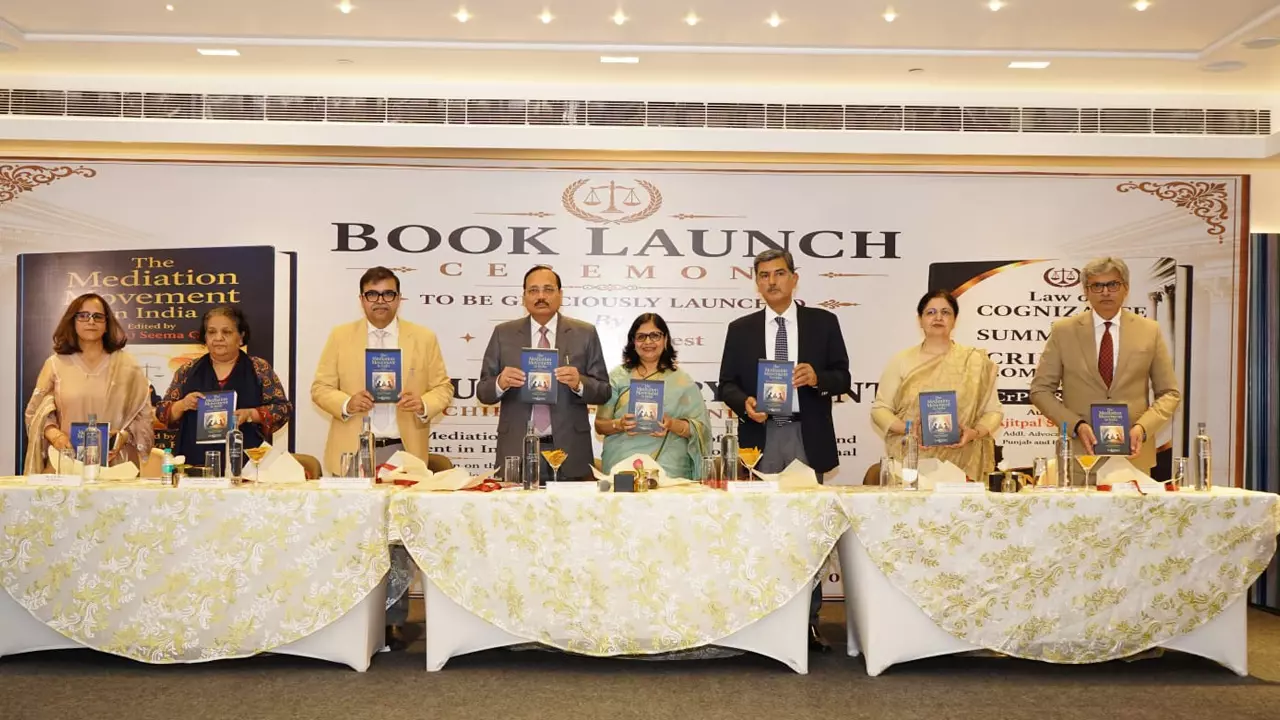
Chief Justice of India Surya Kant on July 18, 2026 launched The Mediation Movement in India at Chandigarh, a book edited by Prof. (Dr.) Seema Gupta that examines the evolution of mediation in India with a special focus on the Mediation Act, 2023. The book, edited by Prof. (Dr.) Seema Gupta, Professor of Law at the University Institute of Legal Studies (UILS), Chandigarh University, has been published by Law and Justice Publishing Company. The Chief Justice has also authored the Foreword to the publication. The publication comprises twenty-four chapters contributed by twenty-six authors, including judges, advocates, senior trainers of the Mediation and Conciliation Project Committee (MCPC) of the Supreme Court, practising mediators and legal academics. It covers a wide range of topics, including the Mediation Act, 2023, pre-litigation and institutional mediation, family and commercial disputes, online dispute resolution, artificial intelligence, and ethical and practical challenges faced in mediation. Speaking at the launch, Chief Justice Surya Kant observed that while the Mediation Act, 2023 could be read in a single sitting, the practice of mediation required far greater understanding and experience. He noted that the book seeks to bridge this gap by explaining the craft of mediation, including how mediators navigate breakdowns in negotiations and address the human dynamics that are often absent from court pleadings. The launch comes at a time when more than five crore cases are pending before courts across the country. The Mediation Act, 2023 has provided a statutory framework for mediation, while the Mediation for the Nation Campaign 2.0, led by the MCPC and the National Legal Services Authority (NALSA) under the leadership of Chief Justice Surya Kant, is currently underway. According to the press release, the first phase of the campaign resulted in the settlement of over one lakh cases nationwide. In the Preface, Prof. Gupta states that India's longstanding trad
The micro, small and medium enterprises (MSMEs) of our country have often been referred to as the backbone of India's growth. Data from official sources would reveal that in the year 2009 there were only 3.62 crore registered units. Today, there are more than 8.87 crore such enterprises accounting for about 35% of India's total manufacturing capabilities and 31% of the total GDP. Various schemes have been established over the years to ensure that that the MSME sector thrives, such as subsidies, reduction in manufacturing costs and collateral-free loans. The Hon'ble Finance Minister even proposed this year in the budget prepared for 2026-27, to establish dedicated funds (called the SME Growth Fund) upto Rs. 10,000 crores for boosting the liquidity. Along this outlook, the legislature had their eyes set at the plight of MSME entities for whom the timely payments against the goods and services supplied to buyers mattered the most. In 1993, thus, the Interest on Delayed Payments to Small Scale and Ancillary Industrial Undertakings Act was enacted, which was later repealed and replaced by the Micro, Small and Medium Enterprises Development Act, 2006 ('MSMED Act'), with the former introducing dedicated recovery mechanisms, through the establishment of Facilitation Councils, for payments delayed to the enterprises. In 2017, the 'MSME Samadhaan portal' was introduced as an ease of filing applications and redressal mechanism for delayed payments. The legislations had many colourful provisions such as higher rates of interests to be awarded, statutory payment deadlines and arbitration as a mode of dispute resolution. By and large, the new MSMED Act took its structure similar to the erstwhile 1993 Act, but, introduced a crucial difference through its Section 18(5), stipulating that a reference to adjudicate the dispute of non-payment by a MSME enterprise shall be decided within a period of 90 days from the date of making such a reference. This was ambitious and bolstered many
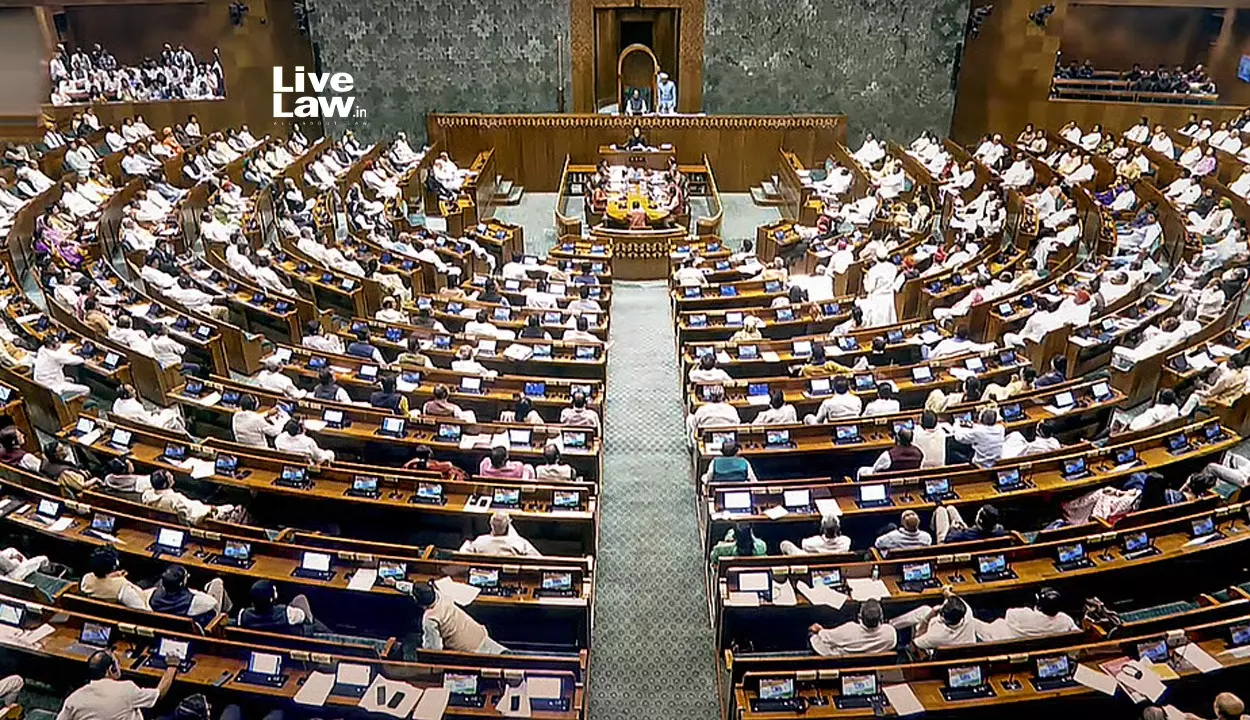
The Parliament has cleared the Micro, Small and Medium Enterprises Development (Amendment) Bill 2026, bringing in changes to the MSMED Act which seeks to facilitate growth and development of the MSME sector.� The Bill was passed by the Lok Sabha on August 7 subsequent to its passing by the Rajya Sabha on August 3. The bill now awaits President of India's assent.� The salient features of the amendments to the MSMED Act are: 1. Aligning MSMED Act with changing landscape: Classification based on� “Investment in plant/machinery” and “Turnover” has been incorporated. The Bill provides permanence to the Udyam Registration Portal as a Digital, free, and voluntary registration platform for MSMEs. However registration for MSMEs is "voluntary".� 2. Strengthening�mechanism for addressing Delayed Payments and provide for enforcement of arbitral awards for the MSEs: The amendment provides for Online Dispute Resolution ensuring MSMEs are able to resolve their disputes in a timely and cost-effective manner. Mandates payment of at least 50% of the awarded amount to the micro and small enterprises suppliers, if the application to set aside decree, award or order is pending for more than 6 months. 3. Ensuring�faster adjudication of delayed payments disputes: The amendment introduces timelines to ensure faster adjudication of delayed payment disputes. Thus the MSEFCs or mediation service provider, as the case may be, is required to complete the mediation within 90 days from the date fixed for first appearance.� The MSEFCs are required to refer the matter for arbitration within 30 days from the date of termination of mediation. Subsequently, the MSEFCs or any institution or centre providing alternative dispute resolution services, as the case may be, is required to make the award within a period of ninety days from the date of completion of pleadings. 4. Strengthening recoveries: The amendments provide that any mediated settlement agreement or arbitral award made by the Facilitation Co
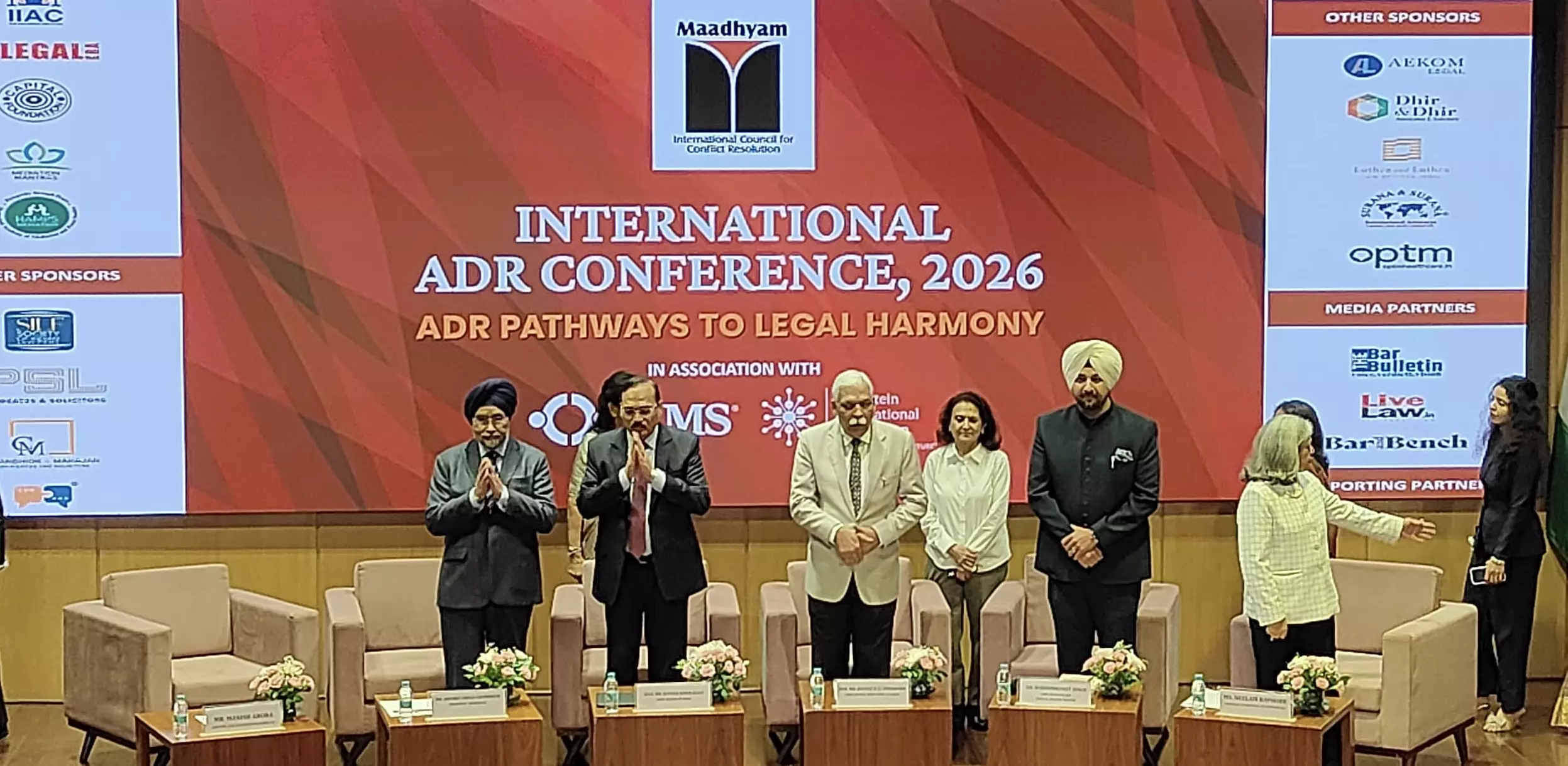
Chief Justice of India, Justice Surya Kant on Friday said that the sine qua non of mediation is “deeply psychological” in nature and that there is no reason why India cannot establish itself as a genuine centre of mediation for the global community. He said that it is not enough to merely have adequate dispute resolution infrastructure but it is essential that India develops itself into a state-of-the-art framework that keeps pace with the country's astronomical growth. CJI was speaking at the International ADR Conference, 2026, organized by Maadhyam International Council for Conflict Resolution. The function was held at S Block building of the Delhi High Court. Justice Kant said that research across jurisdictions consistently showed that people are more likely to honour agreements that they have helped formulate. He said that mediation in India has undergone a significant transformation over the past two decades. CJI added that institutional mediation centres today function with trained professionals, case managers, secure digital systems and online dispute resolution platforms that enable parties in different countries to resolve disputes efficiently. “Most notably, hybrid processes are emerging, exemplified by practices such as med-arb-med. This approach begins with mediation, allowing parties to find common ground. If a deadlock persists on a specific issue, an arbitrator intervenes briefly to resolve it,” CJI said. He added: “Afterwards, the parties return to mediation, integrating that decision into a more comprehensive and lasting settlement. This method combines arbitration's rigor with mediation's sense of ownership, showing that the field is evolving not as a competition between techniques but as a careful integration of both.” Further, CJI said that the Mediation Act, 2023 gave India, for the first time, a standalone statutory architecture for mediation, recognising party autonomy in the choice of mediator and procedure, granting mediated settlement agree